
Anuradhapura with a private driver
Anuradhapura was the first great capital of Sri Lanka, ruling as the seat of government and the heartland of Sinhalese Buddhist civilisation for over 1,300 years from approximately the 4th century BC until the 10th century AD. What remains is extraordinary: dozens of enormous brick dagobas (reliquary monuments) rising above the scrub forest, the ruins of ancient hospitals, monks' quarters, meditation platforms and bathing ponds spread across an area of roughly 40 square kilometres, and — still standing at the centre of it all — the Sri Maha Bodhi, a sacred fig tree grown from a cutting of the Bodhi tree in Bodh Gaya, India, under which the Buddha attained enlightenment. The cutting was brought to Sri Lanka by Princess Sanghamitta in 288 BC, and the tree has been tended continuously ever since — making it the oldest historically documented living tree on earth. Anuradhapura is not a dead archaeological site: it is a living sacred city where Buddhist pilgrims from across Sri Lanka come daily to worship at the dagobas and the Bodhi tree, and where the ruins and the active religious community exist side by side. Dress codes apply throughout (shoulders and knees covered, shoes removed at the sacred areas). The scale of the site makes a private vehicle essential — the major monuments are several kilometres apart and the heat of the Cultural Triangle plain is intense by mid-morning.
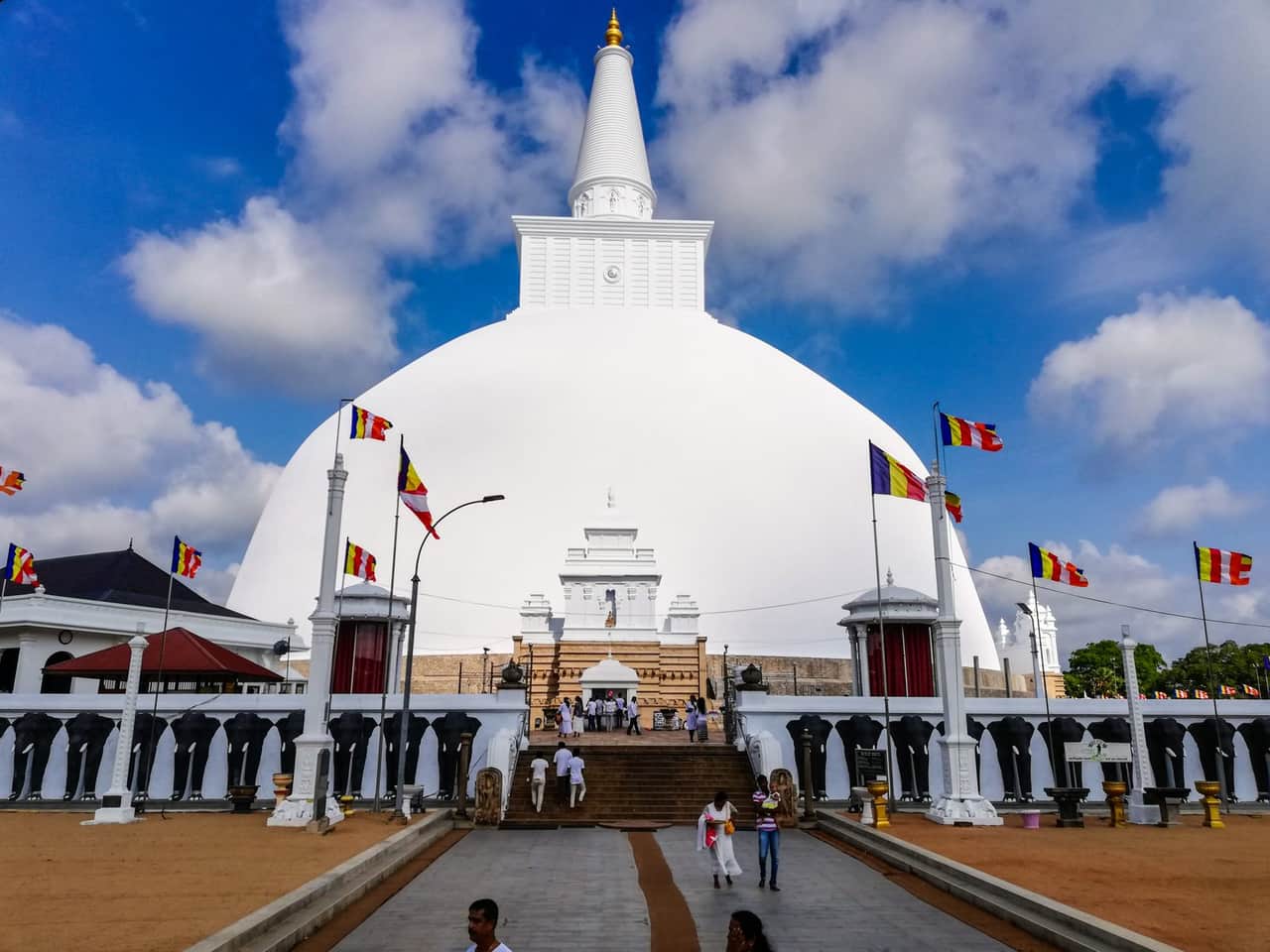
What your driver shows you in Anuradhapura
- Sri Maha Bodhi — the world's oldest documented living tree
- Ruwanwelisaya dagoba (91m high, 288m circumference)
- Jetavanaramaya — once the third-tallest structure on earth
- Mihintale Hill — the birthplace of Buddhism in Sri Lanka
- Isurumuniya rock temple with the 6th-century Lovers carving
The sacred fig tree and the great dagobas
The Sri Maha Bodhi stands in a gilded enclosure near the centre of the sacred precinct and is the most venerated site in Anuradhapura — pilgrims arrive daily in white robes to offer flowers, light incense and meditate. Non-Buddhist visitors can enter respectfully (shoulders and knees covered, shoes removed) and observe the worship, which is authentic and continuous rather than staged for tourists. The great dagobas nearby are the most visually dramatic monuments: the Ruwanwelisaya, commissioned by King Dutugamunu in 140 BC, is a white hemisphere 91 metres high with a circumference of 288 metres; the Jetavanaramaya, built in the 3rd century AD, once stood over 120 metres tall and was the third-tallest structure on earth after the Egyptian pyramids — its partially restored dome still rises 70 metres above the forest. Both contain sacred relics in inner chambers sealed for millennia. The Thuparamaya dagoba, dating to the 3rd century BC, is the oldest in Sri Lanka and the closest to the Sri Maha Bodhi.
Best time to visit Anuradhapura
Anuradhapura sits in the dry zone plains and is hot year-round, but the most pleasant visiting conditions are between December and April when the north-east monsoon brings some rain to cool the air and the vegetation is at its greenest. Arrive early — by 7am if possible — to cover the main sites before the full heat of the day arrives at 10am. Poya days (full moon days in the Sri Lankan calendar, typically monthly) see the sacred precinct at its most atmospheric, with large numbers of pilgrims in white robes carrying flowers and offering lamps — a remarkable sight if you are comfortable with crowds. The site is extensive enough that midday visits to the dagobas on the western periphery, where shade is more available, are manageable even in hot weather. October and November can bring rain from the north-east monsoon, but the site is largely outdoor ruins and the weather rarely stops a visit entirely.
How to get to Anuradhapura
The simplest way to reach Anuradhapura is with a private driver: you're met at Colombo Airport (CMB) with a name board and driven door to door, with no timetables, bus changes or luggage hassle. Because the daily rate is charged per vehicle rather than per person, it's also the best value for couples, families and small groups.
Anuradhapura FAQs
How much is the Anuradhapura entrance fee?
Foreign visitors pay USD $25 per person for the Anuradhapura Archaeological Site ticket, managed by the Central Cultural Fund. This covers all the major monuments within the sacred precinct. Mihintale Hill (12km east of town) requires a separate ticket. Check current fees at the Central Cultural Fund website before your visit.
Is Anuradhapura or Polonnaruwa better to visit?
They complement each other rather than compete. Anuradhapura is larger, older and more sacred — a living pilgrimage city with enormous dagobas and the Sri Maha Bodhi. Polonnaruwa is more compact, better preserved in places, and has the famous Gal Vihara rock sculptures of the Buddha. If you can only visit one, Anuradhapura offers more emotional and spiritual weight; Polonnaruwa is more approachable for a half-day.
Can I visit Anuradhapura in a day?
The main sacred precinct can be covered in a full day with a private vehicle. The ruins are spread over several kilometres of rough roads, so a car is essential — cycling is also popular and bicycles can be hired near the site entrance. A half-day covers the Sri Maha Bodhi and two or three of the major dagobas. Adding Mihintale (birthplace of Buddhism in Sri Lanka, 12km east) makes a satisfying full-day programme.
Do I need to dress modestly at Anuradhapura?
Yes — throughout the sacred precinct, both men and women are required to cover shoulders and knees. White attire is not required for visitors but is conventional among pilgrims. Shoes must be removed at the Sri Maha Bodhi enclosure and at some dagoba bases. Most of the site is barefoot, so the early morning before the ground heats up is the most comfortable time to walk.
Useful resources for visiting Anuradhapura
Related reading
See Anuradhapura at your own pace
One trusted driver, transparent daily rate, and a route you can change any time. Free airport pickup on longer tours.
Plan my tripNo payment now · Free cancellation up to 7 days